Operation Basanti: How NDRF Leveraged Advanced Marine Robotics in West Bengal
Operation Basanti began as a rescue effort in one of the most challenging river systems in eastern India. On April 28, 2025, a tourism vessel capsized in the Matla River near Basanti, West Bengal, following adverse weather and unstable tidal conditions. Strong cross-currents and heavy sedimentation quickly reduced underwater visibility to near zero. Of the five individuals onboard, three managed to escape, while two remained unaccounted for beneath the surface.
2BN NDRF responded immediately, initiating a structured underwater search and recovery operation. The Matla River, like many inland waterways in India, presents complex operational challenges — high turbidity, shifting riverbeds, tidal flow variations, and limited optical visibility. In such environments, traditional diver-led search operations alone can significantly increase risk exposure and search duration.
To enhance their capability, NDRF integrated advanced marine robotics technology into the operation, deploying Remotely Operated Vehicle (ROV) systems and underwater drone platforms engineered for low-visibility river conditions. These underwater robotics systems, developed by Banergy, are designed specifically for subsea inspection, sonar-based localization, and river search operations in India.
As the ROV descended into the sediment-heavy current, visual cameras provided minimal clarity. Instead, high-resolution scanning sonar imaging became the primary detection tool. Unlike optical systems, sonar imaging technology operates effectively in turbid water, mapping submerged structures through acoustic reflection. This capability is critical for underwater search and recovery missions in India’s rivers, where visibility often drops below usable limits.
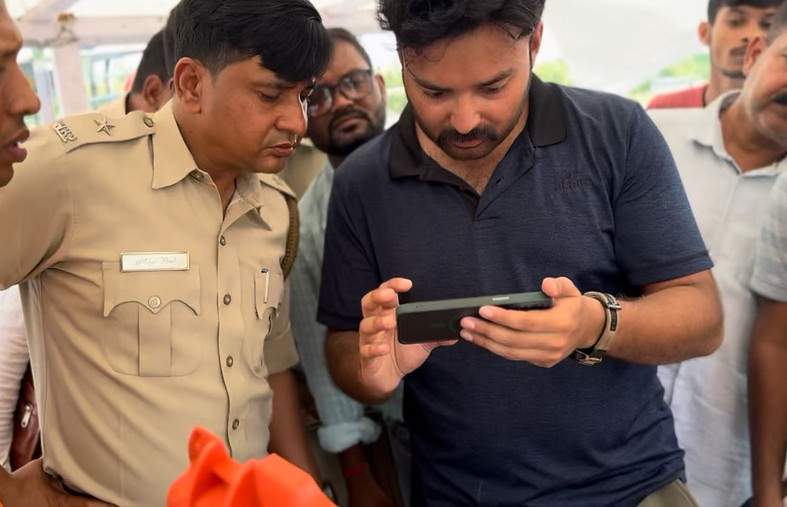
Initial sonar sweeps returned acoustic noise from debris and irregular riverbed formations. In silt-dense inland waters, distinguishing a capsized vessel from background reflections requires calibrated maneuvering, controlled depth positioning, and multi-angle sonar validation. The ROV system continued scanning methodically, generating real-time subsea imaging data and structural mapping feedback for the NDRF operators monitoring the surface control station.
A consistent structural return soon emerged on the sonar display. Further acoustic passes confirmed the geometry of a submerged vessel resting approximately 15.5 meters below the surface within a total water column of around 25 meters. Sonar-based target verification was conducted across multiple ranges to eliminate false positives — a critical protocol in underwater robotics operations involving high sediment density. The structure measured an estimated 15 to 20 meters in length and 5 to 8 meters in width, positioned laterally with partial silt embedding.
Through advanced ROV systems and underwater drone deployment, uncertainty was converted into measurable geospatial data. Depth assessment, structural orientation, and target localization were achieved without exposing divers to hazardous currents during early-phase detection. In modern marine robotics operations, sonar-guided underwater vehicles reduce risk while accelerating underwater search timelines.
During the operation, tidal forces temporarily affected positional referencing. To maintain accuracy, NDRF leveraged an Autonomous Surface Vehicle (USV) equipped with integrated sonar mapping and GPS geotagging systems. The USV platform enabled surface-level stabilization and refined the vessel’s coordinates to within an estimated 5 to 10 meters. This integration of ROV and USV marine robotics platforms highlights the growing importance of autonomous systems in India’s disaster response ecosystem.
Operation Basanti demonstrates how marine robotics in India is transforming underwater search and recovery capabilities. By combining ROV systems, underwater drones, sonar imaging technology, and autonomous surface vehicles, NDRF conducted high-precision river search operations in conditions where visibility, current velocity, and sediment load severely limited conventional methods.
The heroes of the operation were the NDRF personnel executing the rescue and recovery effort. The marine robotics systems worked in the background — scanning, mapping, verifying, and delivering real-time subsea intelligence. Banergy’s role was not to lead the mission, but to ensure that the underwater robotics technology supporting India’s disaster response teams performed reliably under demanding riverine conditions.
As inland waterway traffic, port infrastructure, and coastal development expand across the country, the demand for underwater drones in India, ROV systems for inspection, subsea robotics for localization, and sonar imaging for search operations continues to grow. Advanced marine robotics is no longer limited to offshore oil and gas environments — it is becoming essential infrastructure for river safety, port security, bridge inspection, and disaster response.
Operation Basanti stands as a clear example of how marine robotics technology enables national response agencies to operate with greater precision, reduced risk, and enhanced situational awareness in India’s most challenging underwater environments.
In modern underwater search and recovery operations, technology does not replace human courage. It empowers it.
.jpeg)


.jpeg)
.jpeg)
.jpeg)
.jpeg)


.jpeg)
.jpeg)

.jpeg)

.jpeg)
.jpeg)
.jpeg)

.jpeg)
